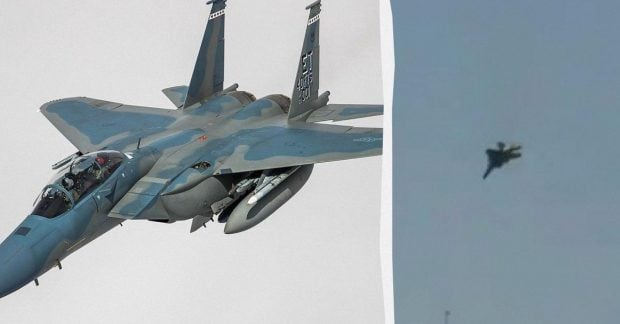
American F-15E Strike Eagle Crashes Near Kuwaiti Base: What We Know
On a recent Monday morning, international headlines were dominated by reports of an American F-15E Strike Eagle fighter jet crashing in Kuwait. The incident, which occurred near a key U.S. military installation, immediately sparked concern and launched a swift response from both Kuwaiti and American authorities. While the full details surrounding the crash are still emerging, initial reports have provided a clear picture of the dramatic event and the fortunate outcome for the crew involved.
The crash of the formidable American US F-15 Fighter Jet in Kuwait has naturally drawn significant attention, particularly given the aircraft's critical role in regional security operations. This article will delve into the known facts, explore potential circumstances, and discuss the broader context of this significant aviation incident.
The Incident Unfolds: A Close Call in Kuwaiti Skies
The dramatic event took place on Monday, March 2nd, when an F-15E Strike Eagle, a highly advanced American twin-engine fighter jet, experienced a catastrophic failure and crashed. Videos quickly circulated on social media platforms, capturing the harrowing moments as the aircraft descended uncontrollably before impacting the ground. Eyewitness footage, often shaky and distant, showed the plane in a spiral, engulfed in flames, underscoring the severity of the malfunction.
Crucially, these same videos offered a glimmer of hope amidst the chaos: at least one crew member was seen ejecting from the stricken aircraft, their parachute deploying against the backdrop of the Kuwaiti sky. This crucial detail was soon confirmed by official statements and local reports. The pilot, having successfully executed the emergency procedure, landed safely and, remarkably, sustained no serious injuries.
Local residents near the crash site played a vital role in the immediate aftermath. Photographs shared online showed rescue operations underway, with locals assisting the pilot who had ejected. Their swift actions were instrumental in ensuring the pilot's safety and facilitating their transfer to local authorities. The incident occurred approximately 10 kilometers (6.2 miles) from the American Ali Al Salem Air Base, highlighting its proximity to a major operational hub.
Adding a layer of complexity to the initial reports, the Kuwaiti Ministry of Defense issued a statement, through Colonel Said Al-Atwan, referring to the crash of "several" American military aircraft. The statement confirmed that all crew members involved in these incidents survived and were in stable condition after receiving necessary medical attention at a local hospital. This suggestion of multiple US military jets crashing in Kuwait prompted further questions, though subsequent reporting largely focused on the single F-15E incident.
The F-15E Strike Eagle: A Dual-Role Powerhouse
The aircraft involved, an F-15E Strike Eagle, is a cornerstone of the U.S. Air Force's combat capabilities. Developed from the venerable F-15 Eagle air superiority fighter, the 'E' variant is a highly versatile, dual-role fighter designed for both air-to-air combat and precision deep-strike missions. Its ability to carry a substantial payload of air-to-ground ordnance, coupled with advanced avionics and a two-person crew (pilot and weapon systems officer), makes it an invaluable asset in complex operational theaters.
The F-15E's presence in Kuwait underscores its strategic importance in maintaining regional stability and projecting power. Its operational deployment often involves complex missions, ranging from close air support to interdiction and reconnaissance. The loss of such an advanced asset, even without casualties, represents a significant event for military planners.
It's worth noting that while the F-15E was definitively identified through circulating videos and subsequent reports, initial analyses, including one by CNN, noted that the twin-engine jet's silhouette could also resemble an F/A-18 Hornet. This confusion was compounded by the fact that Kuwait's own air force operates F/A-18s, but the eventual confirmation pointed squarely to the F-15E, an American asset.
Unraveling the Mystery: Potential Causes and Speculations
Whenever a sophisticated military aircraft like an F-15E crashes, the immediate question that arises is, "Why?" Military aviation incidents are complex, and investigations typically take weeks or even months to yield definitive conclusions. In this case, several hypotheses have been put forward, although official confirmation remains pending.
- Mechanical Failure: This is a common cause in aviation accidents. A critical system malfunction, engine failure, or structural compromise could lead to a loss of control.
- Human Error: While highly trained, pilots are not immune to errors, especially during challenging operational conditions or unforeseen emergencies.
- Geopolitical Context: The incident occurred amidst ongoing U.S. military operations in the region, including actions related to Iran. Some early speculations attempted to link the crash to these heightened tensions, though no credible evidence has supported direct hostile action against the F-15E.
- "Friendly Fire" or Air Defense Malfunction: OSINT (Open Source Intelligence) channels, which often analyze publicly available information, briefly speculated on the possibility of "friendly fire" – an accidental attack by allied forces. Separately, Iranian sources made unverified claims that they had downed the jet, while others considered the possibility of a malfunction in Kuwaiti air defense systems. However, these remain unconfirmed speculations lacking official corroboration.
The Kuwaiti Ministry of Defense confirmed that it is in "direct coordination" with U.S. authorities to investigate the incident thoroughly. Such investigations involve analyzing flight recorders (if recovered), interviewing crew members and witnesses, examining wreckage, and reviewing maintenance records. The goal is to determine the precise sequence of events leading to the crash, identify contributing factors, and implement measures to prevent future occurrences.
Understanding the actual cause behind the **истребитель разбился кувейт** event is paramount not only for military safety but also for maintaining transparency and preventing misinformation, which can quickly proliferate in such high-stakes situations.
The Aftermath and Broader Implications
The primary concern following any military aircraft crash is the well-being of the crew. In this incident, the successful ejection and survival of the F-15E pilot represent a testament to both the robust design of modern ejection systems and the swift response of local emergency services and citizens. The rapid provision of medical attention ensures that the crew members, despite the trauma of the event, receive immediate care for any physical or psychological impacts.
From an operational standpoint, the loss of an F-15E, while significant, is generally accounted for within military asset management. However, it prompts an immediate review of operational procedures, maintenance protocols, and flight safety measures to mitigate future risks. The seamless coordination between U.S. and Kuwaiti authorities in managing the crash site, conducting rescue operations, and initiating investigations highlights the strong strategic partnership between the two nations.
For individuals interested in aviation safety or military operations, such incidents underscore the inherent risks associated with advanced combat aircraft. It also offers a reminder of the incredible engineering behind safety systems like ejection seats, which are designed as a last resort to save lives in the face of catastrophic failure. While the exact cause of this specific **истребитель разбился кувейт** remains under investigation, the outcome for the crew serves as a powerful testament to their training and the effectiveness of modern safety technology.
The incident serves as a stark reminder of the complexities and inherent dangers involved in military aviation, even during routine operations or training flights. The U.S. and Kuwaiti authorities are committed to a thorough investigation to ascertain the definitive cause of the F-15E Strike Eagle crash. The focus remains on ensuring the safety of personnel and equipment, and learning valuable lessons to enhance future flight operations. The successful ejection and rescue of the pilot offer a fortunate silver lining to an otherwise serious event, underscoring the effectiveness of emergency protocols and the invaluable role played by local communities in times of crisis.